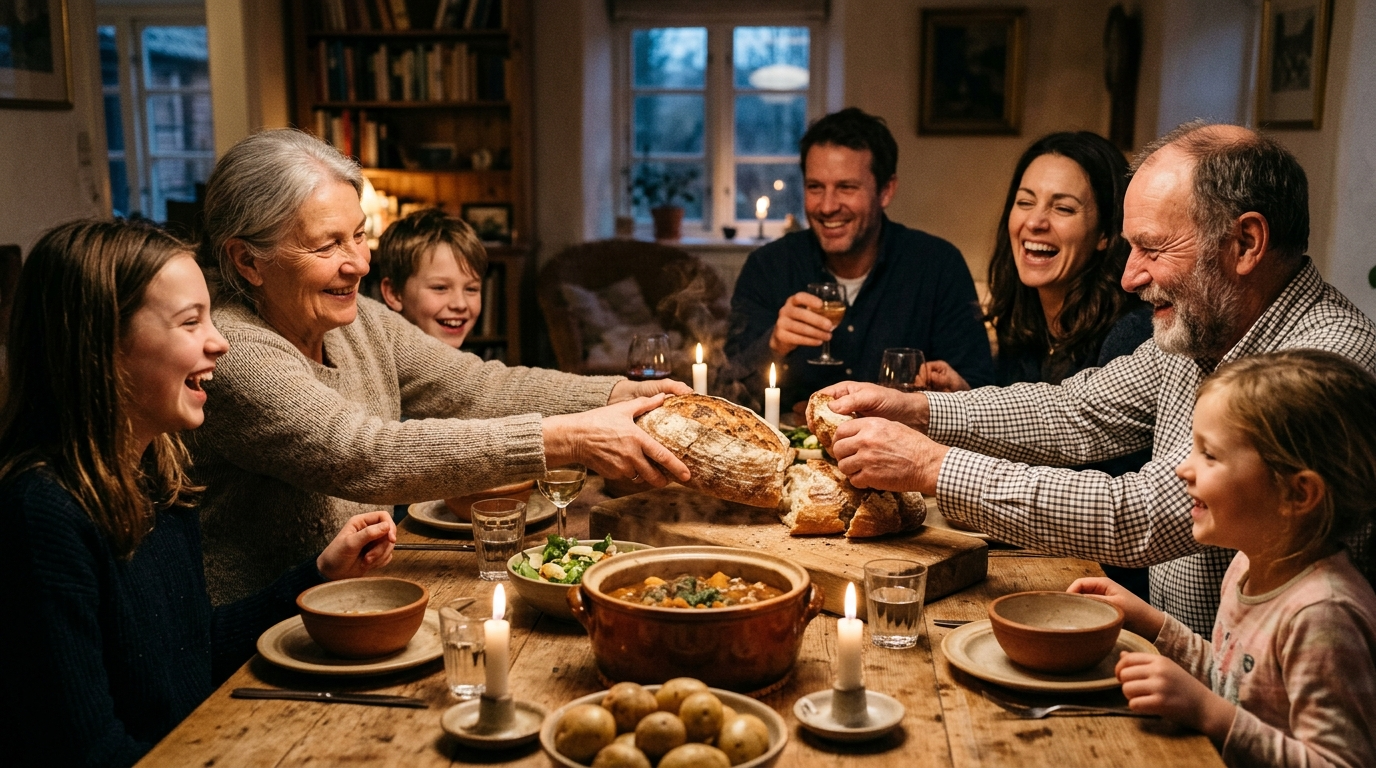
In an era of digital noise and constant hustle, our homes often resemble hotels where we pass each other in hallways, clutching smartphones instead of the hands of our loved ones. And yet, in the heart of each of us, there flickers a longing for something primal and sacred.
This longing finds its fullest expression at the table. It is not just a piece of furniture. It is a space where biology meets spirituality, and physical hunger becomes a pretext for nourishing the soul.
The Liturgy of the Everyday Hidden in the Scent of Bread
When we sit down to a meal together, something almost sacramental happens. Eating together is the oldest language of love. It is a moment when we say to one another: *You are important to me. Your time is more precious to me than my urgent phone notifications.*
Modern psychology confirms what Christianity has known for centuries: children who eat meals with their parents feel more secure and are less prone to mental health crises. The table creates a safe haven where the chaos of the outside world is briefly halted by the rhythm of passing plates.
It is worth noting that the Gospel is full of scents and flavors. Jesus did not only teach in synagogues. He was constantly sitting at the table. He feasted with tax collectors, sinners, and friends in Bethany. He left us the most important testament of His love not in the form of a philosophical treatise, but in the form of a shared supper.
Emmaus is a key image for our domestic theology. The disciples recognized the Lord not after a profound lecture on Scripture, but in the “breaking of the bread.” Our family dinners can be just such an “Emmaus.” It is there, between the request for salt and the story of a difficult day at school, that Christ reveals Himself. He is present in the patience with which we listen to one another and in the joy of being together.
The Table as a Domestic Altar of Hope
Many of us fear that our family meals are too imperfect to have a spiritual dimension. Someone is late, someone grumbles that the soup is too salty, and conversation sometimes turns into an argument. But it is precisely within this fragile human reality that hope is born.
Christian hope does not consist in everything being perfect. It consists in the fact that there is always room for forgiveness at the table. A shared meal is a practice in humility and mindfulness. It is an opportunity to feed not only the body but also another person's sense of belonging.
Let us start with small steps. Perhaps it could be one shared dinner a week without the television or phones. Let the table become a place where we celebrate life, give thanks for the gifts of the earth, and above all—for one another. For where there is love and community, God is always there.
#family #faith #meal #community #hope