“I am the resurrection and the life. He who believes in me will still live, even if he dies.”
John 11:25
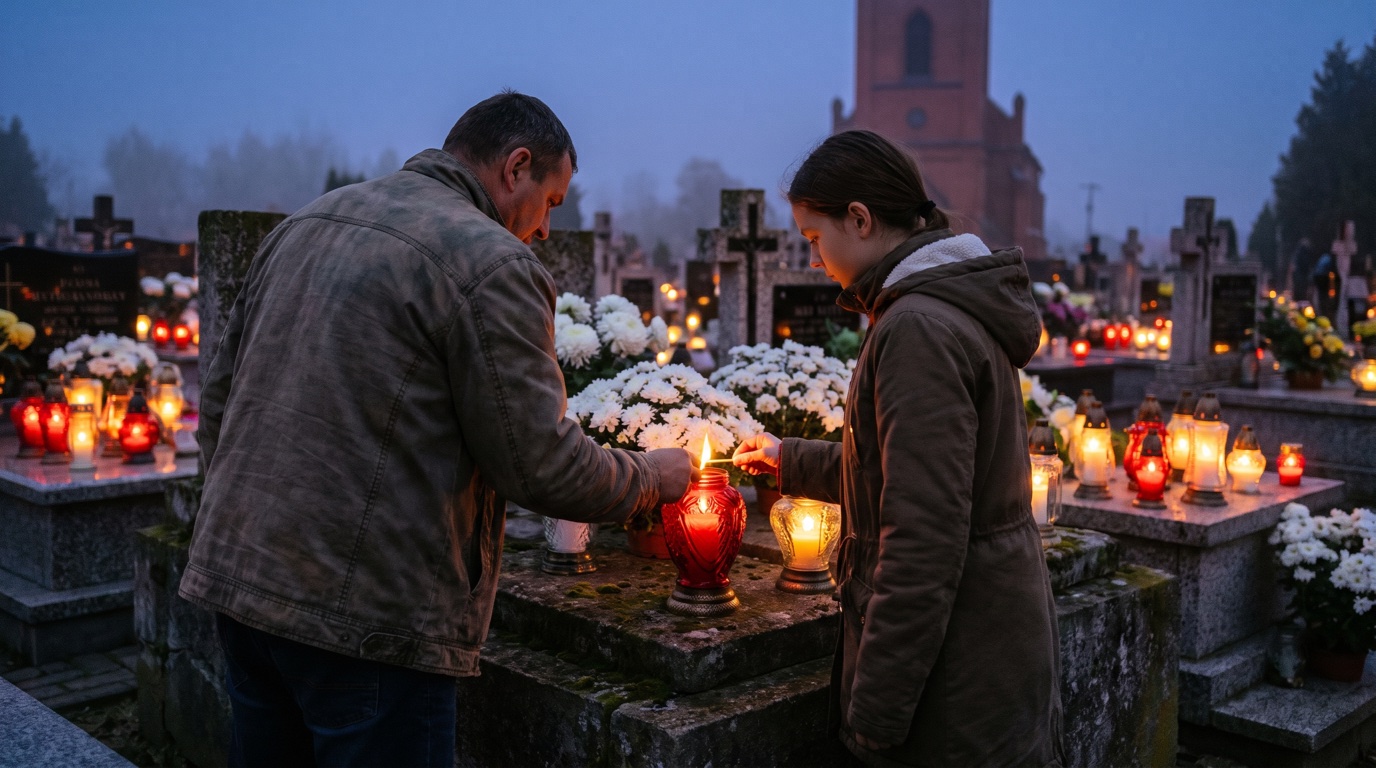
On November evenings, cemeteries in many Catholic countries glow with thousands of candles. It is one of the most beautiful images of our faith. Families travel from far away, tidy the graves, and stand for a moment in silence. Someone prays, someone simply looks at a photograph on the stone. All Souls Day touches what is most fragile in us: our longing for those we have loved.
Grief is not a lack of faith
Believers sometimes feel they should not cry, since they believe in eternal life. The Gospel says otherwise. At the tomb of Lazarus, Jesus was deeply moved and wept. The same Jesus who is about to raise His friend is not ashamed of tears. Grief, then, is not a lack of faith. It is the price of love.
Saint Paul writes to the Thessalonians that he does not want us to grieve “like the rest, who have no hope” (1 Thessalonians 4:13). He does not forbid sorrow. He shows that Christian sorrow has a different foundation. Beneath the tears lies the hope that death does not have the last word.
A prayer that unites
From the beginning, the Church has prayed for the dead. The Catechism recalls that Scripture already speaks of offering sacrifice for the dead, and that the Church also commends almsgiving, indulgences and works of penance on their behalf (CCC 1032). This is not an empty custom. It expresses the conviction that the bond of love does not end at the moment of death.
When we pray for our loved ones, we are still doing something for them. We are not helpless. A Mass offered for them, a rosary prayed at the grave, an indulgence offered in the first days of November are concrete gifts. The communion of the Church embraces the living and the dead, and prayer is the bridge between them.
Memory that heals
All Souls Day is also a chance to bring order to our memories. At the graves, not only good memories return. Unfinished conversations return, words we did not manage to say, sometimes regret or guilt. It is worth entrusting all of this to God. He knows our hearts and the hearts of those who have gone before us.
At the grave we can say in our hearts what was left unsaid. To apologize, to thank, to forgive. Prayer for the dead can also become a prayer for the healing of our own wounds.
A small practice for these days
When you visit the cemetery, pause not only at the graves of your own family. Light a candle at a forgotten grave too, one where no one has left flowers for a long time. Say a short prayer for a person whose name you may not even know. It is a small gesture that reminds us that in God's family no one is forgotten.
In the evening, read slowly the words of Jesus: “In my Father's house are many homes” (John 14:2). Think of your loved ones as those for whom Jesus has prepared a place.
A light that does not go out
The candles in the cemeteries will eventually burn out. But their flame is a sign of something lasting. Christ, the light of the world, passed through death and opened the way to life. The question He asked Martha, Jesus asks us too: “Do you believe this?” (John 11:26).
All Souls Day is an invitation to answer that question not only with words, but with all our hope.
#AllSouls #PrayerForTheDead #Hope #Grief #homileo
Back to the blog