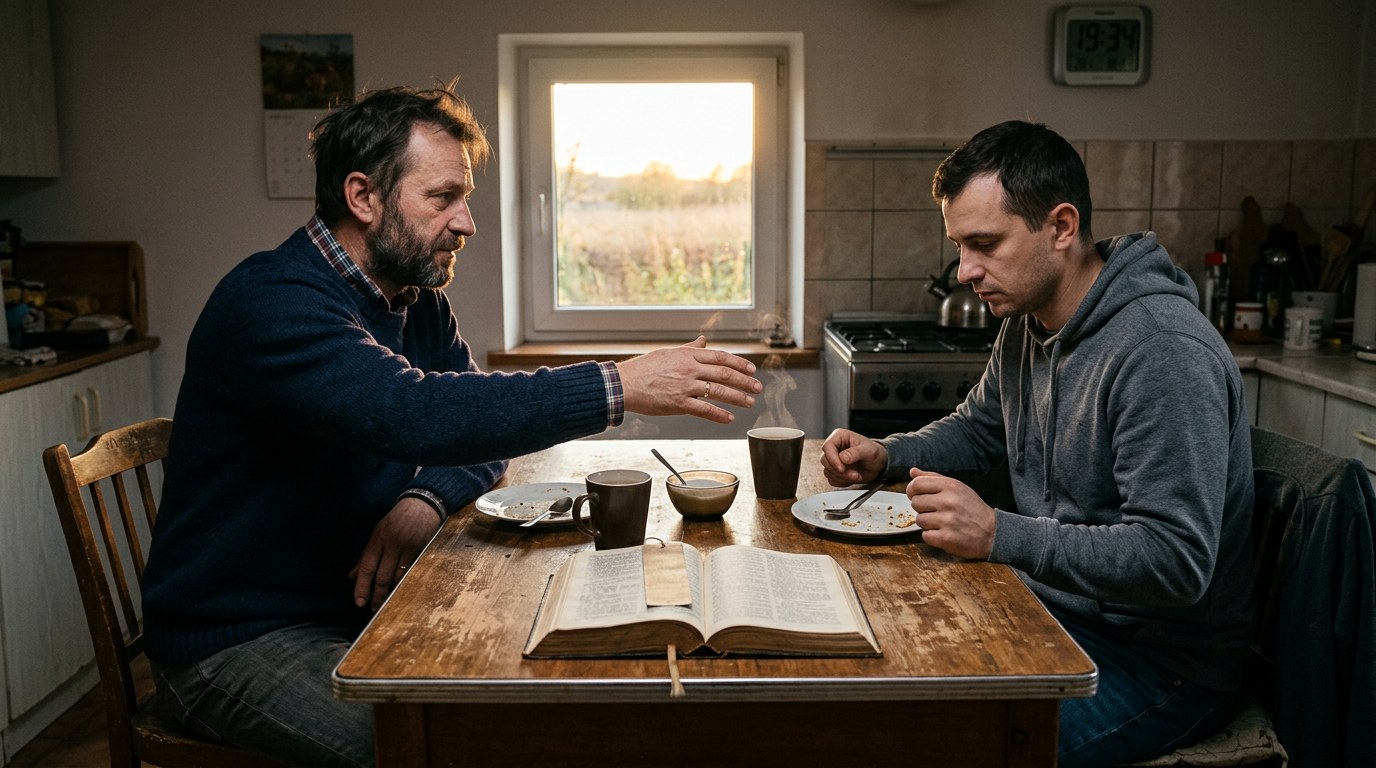
Cain said to his brother Abel: let us go out to the field. And when they were in the field, Cain rose up against his brother and killed him.
— Genesis 4:8
The first crime in human history was not a war between tribes. It was not an attack by a foreign enemy. It was fratricide. From the very beginning, the Bible shows the brutal truth: the hardest battle is not the one with the distant stranger, but the one with someone we know, someone we love, someone with whom we share a table and a history.
The words God later spoke to Cain, asking whether he was his brother's keeper, sound shockingly relevant today. Because we are our brother's keepers. Family, community, nation, Church: all of these structures become a civil war when we stop seeing a brother in the other and start seeing an enemy.
How civil war is born
Civil war rarely begins with weapons. It begins with a word that wounds. With a label we stick on someone: he is one of them, she thinks differently, they are not our kind. It begins with the division into us and them, even when us and them are sitting at the same table.
Cain did not wake up one day a murderer. First came anger. Then envy. Then the feeling that his brother had taken something that was his: recognition, love, a place. Envy is the quiet seed of every civil war, in the family, in the parish, and in society. God himself says to Cain that sin is crouching at the door, waiting for him. It is a terrifying image, because the door is always close.
The Gospel reverses the logic of fratricide
Christ enters precisely at the point where brother turns against brother. He says plainly that whoever hates his brother is already a murderer in his heart. He does not move the boundary of the crime further away; he moves it to where war really begins: inside the human person.
But he does more than diagnose. He reminds us that when we bring our gift to the altar and remember that a brother has something against us, we must first be reconciled with our brother, and only then offer the sacrifice. This is a revolution: reconciliation between people is a condition of worship. God does not want our religiosity if it is built on the wounded bodies of brothers and sisters.
And he goes further still. On the cross, Christ prays for those who are killing him. He dies not in a war against man, but in a war against sin itself, the sin that turns a brother into an enemy. The cross is the final no to fratricide, and the final yes to brotherhood.
A brother is not an optional category
We often think of brotherhood as something we can choose or reject. Whoever thinks differently ceases to be a brother. Whoever votes differently becomes an enemy. Whoever wounds us is written out of the family.
The Gospel knows only one logic: a brother is always a brother. Even when he wounds. Even when he is wrong. The question God asked Cain, whether he was his brother's keeper, has never been revoked. It has only been deepened: the keeper is the one who does not allow his brother to become an enemy within his own heart.
What can I do
A civil war is not won tactically. It is won by changing its nature. A few questions for today:
Has someone appeared in my vocabulary whom I no longer call a brother? Do I repeat stories that turn others into enemies? Is there one person with whom I must be reconciled before I bring my gift again?
Reconciliation does not mean agreeing with everything. It means rejecting one thing: the belief that the other ceases to be a brother. We may argue sharply, but we must not hate. We may defend the truth, but we must not kill a relationship.
A hope that is not naive
God marks Cain and protects him. It is astonishing: God does not allow vengeance, not even against a brother's murderer. The history of salvation does not end with Cain. It ends at the cross, where Barabbas, a prisoner, is set free, and the Son takes his place. Barabbas is every one of us: the one who in some way took part in violence against his brothers and received life as a gift.
We cannot allow brother to fight against brother, not because brotherhood is a sentimental ideal, but because on the cross it was paid for at too great a price. Peace in the family, in the community, in the nation begins not with grand agreements, but with a single gesture: today, withdraw one accusation; today, extend one hand; today, stop seeing an enemy where a brother stands.
I am my brother's keeper. No one else will come with that answer.
#CivilWar #Brotherhood #Reconciliation #Faith #Gospel
Homileo.pl | Homileo.com
#homileo #civilwar #brotherhood #reconciliation #CainandAbel #Gospel
Back to the blog